Causes Of Treatment

Dental Prostheses

We wouldn’t want you to read this article. Because in the first place, your interest in it would mean that you have lost one, a few or all of your teeth. And this is always an unpleasant and traumatic event. And second, because modern dentistry now offers much better alternatives to dentures, which we will tell you about below.
However, for now, dentures remain one of the more popular ways to restore partially or completely edentulous jaws. Therefore, at Vita Dent you can count on a professional, high-quality and effective prosthetic solution that will restore your comfort and smile.

When is it necessary to have dentures placed?

Generally speaking – when a patient has lost one, several, or all of their teeth. This most often happens in older patients, but not always.
In any case, before the prosthetic construction is made, it is necessary to make a detailed examination in order to assess what type of prosthesis would be most suitable for your case. Unlike the days of a few decades ago, today dentistry has evolved in this direction as well to offer patients a variety of modern and workable solutions to restore smile and function.
After the examination, during which we will draw up your treatment plan, we proceed to prepare the jaw for the prosthetic construction. This includes both routine activities such as professional cleaning and – if necessary – treatment of the teeth that will remain in the mouth, as well as their processing – filing to become the basis of the future denture.
With digital scanning, we will take a precise impression of the jaws to then fabricate the dentures with the utmost precision. It is then that we will discuss together and offer you the best option for your case.

What types of dentures are there?

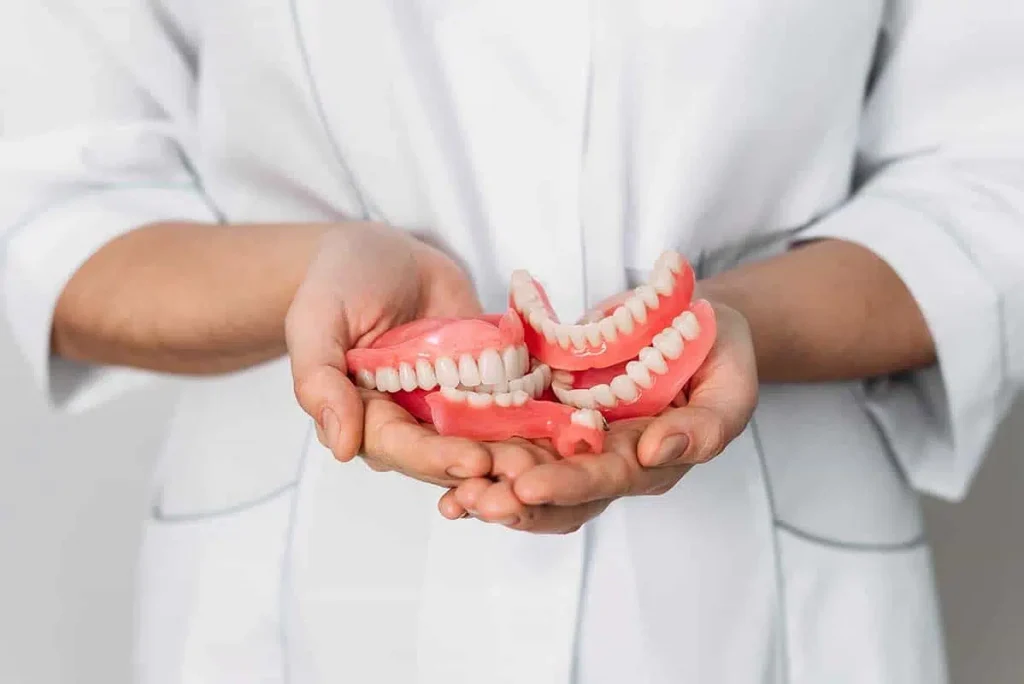
Depending on the case, they may be whole or partial. Most of them are removable, but we hasten to reassure you – don’t imagine “dick” in a glass of water by the bed. Thanks to developments in technology and materials, modern prosthetics offer practical, hygienic and aesthetic ways of storage and maintenance.
Alongside this, there are now alternatives for non-removable dentures that effectively behave like your permanent teeth.
So, the types:

Acrylic dentures

Also known as plaques, they can be whole or partial. These are the most budget-friendly and hence the most common dentures that have a relatively aesthetic appearance and are easy to maintain. The plastic crowns are built on a hard acrylic base in the colour of the gum, which in turn is fixed by vacuum onto the gum. Full acrylic dentures are made for the entire jaw, and partial dentures are attached with wire clips to the adjacent healthy teeth.

Silicone dentures

They are considered to be of the highest quality – because of their comfort and aesthetics. They are made of plastic material and their connection with the rest of the teeth is cast together with the denture – so they remain completely inconspicuous. Due to the elastic material from which they are made, they are extremely resistant. An added plus is that the material from which they are made does not cause allergies.

Microprostheses Dentures

Most often, they are a temporary solution for the loss of one, two or three teeth. The reason patients prefer them is the elastic ties that secure them to the adjacent healthy teeth. This eliminates the need for filing for bridge placement. However, the microprosthesis cannot stay forever. It must be replaced by a permanent one, or by a dental implant.

Joint dentures

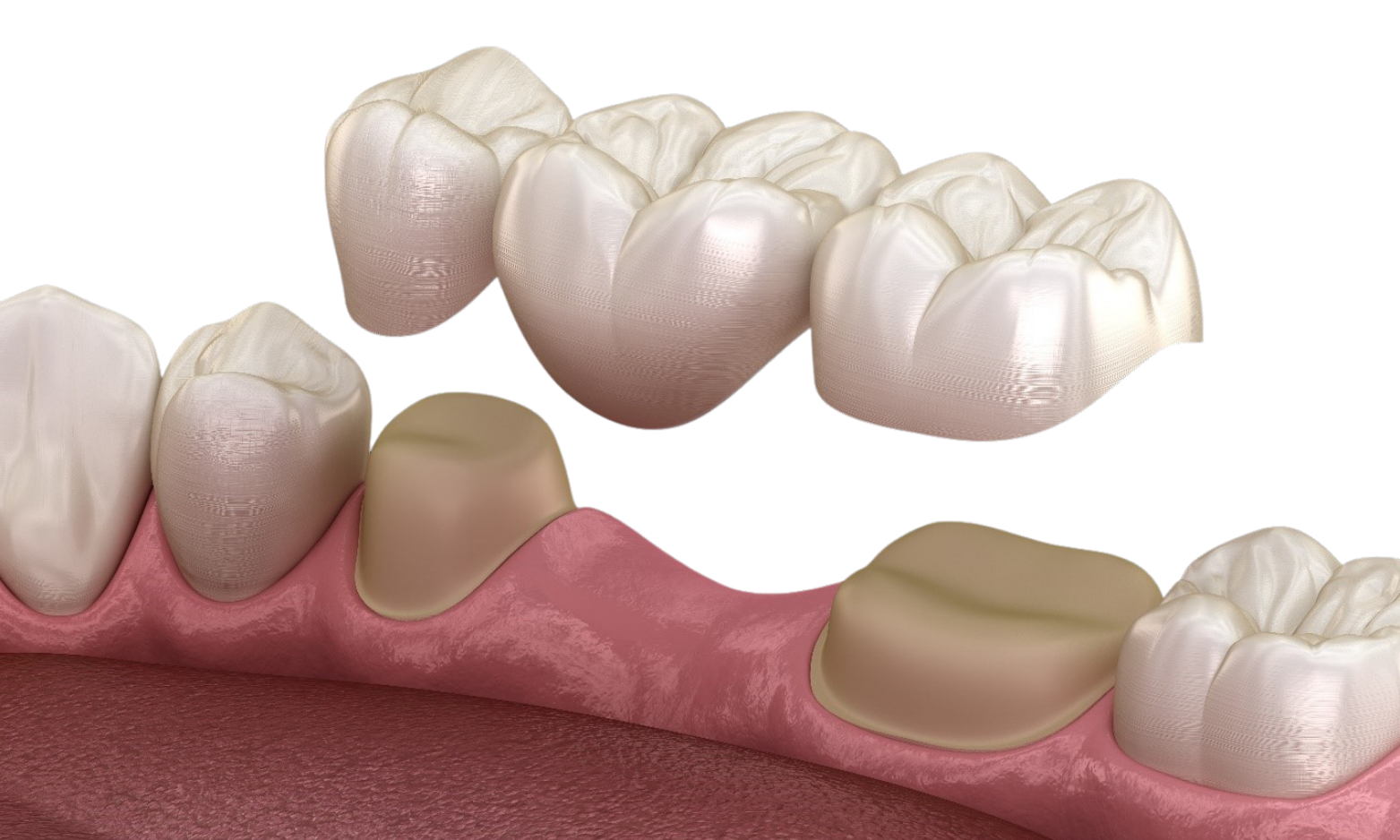
They remotely resemble bridges because they clamp onto the nearest healthy adjacent teeth. This type of denture is recommended for tooth loss on one entire side and is a kind of rail that runs through the space of the missing teeth. Hence the name – the rail serves as a joint for fixing the denture and is a kind of splint that holds the natural teeth.

Skeletal dentures

Also partial dentures on a metal or other hard base, to which patients adapt quickly. They are attached to the upper jaw by a fine plate instead of a palate. And for the lower one – by means of an extremely thin ligament that passes under the teeth and tongue.

Daily life with dentures

Pros of dentures:

The absence of teeth

One or more – affects your lifestyle, your comfort in everyday life, your self-esteem, your health. The inability to properly process food usually leads patients to exclude certain products from their menu, and this disrupts the balanced intake of important substances for the body.

Needless to explain what discomfort patients with missing teeth experience when they smile. Apart from this, tooth loss leads to a change in the contour of the face and it looks more saggy and tired.

Denture fitting can be an effective enough solution for you to all these social, aesthetic and functional inconveniences. However, it is important that it is performed under the guidance of an experienced professional.

Everyday life with dentures

Cons of dentures:

Although modern prosthetics have reached truly high and even luxurious quality, traditional prosthetics for tooth loss still has its drawbacks.

First of all, most dentures are not always stable enough. This can become a constant source of discomfort and inconvenience for the patient – ​​especially when eating and communicating.

Articulation changes. Despite high precision in manufacturing, some types of prosthetic constructions can disrupt the correct pronunciation of certain sounds.

Bone resorption. Dentures largely restore the aesthetic appearance of a smile, but the absence of natural teeth underneath them gradually leads to a reduction in bone tissue in the jaw. Over time, this is also reflected in the shape of the face, which may appear altered.

Possible allergic reactions. Some of the materials used in industrially manufactured dentures contain substances that can cause allergies.

Reduced taste sensations. Dentures cannot completely replace the natural receptors in the mouth, so as a result, the sense of taste of food may be partially lost.

What do we need to know about them?

Alternatives to dentures

Because of all these disadvantages, and despite their advantages, dentistry has long focused on finding alternatives – and it has succeeded! In the past decade, dental implants have become one of the most effective, proven, and practical solutions for lost teeth. A solution that eliminates all the risks listed above.
Most importantly, implant placement prevents bone resorption, as the implant takes on the role of the missing root in dentures, thus maintaining a fresh and natural appearance of the face. In fact, an implant most faithfully imitates the function of the natural tooth you have lost.

Implant treatment does not require the removal of adjacent healthy teeth to which the prosthesis would be attached. Implants are stable and immobile – nothing in the mouth moves and does not interfere with eating, speaking or smiling.

Because of all this, at Vita Dent we recommend dental implant treatment to our patients as the most modern and long-lasting solution for replacing lost teeth.

What do we need to know about them?

What is the treatment?

Implant treatment is the most effective possible solution for the loss of one, several or all teeth. The placement of dental implants in carefully determined positions – previously assessed by the implantologist – allows the creation of a permanent prosthetic construction on them.
The implants themselves are implanted into the jaw through surgical intervention, and after a short recovery period, they integrate into the bone and become part of its structure.
The possibilities for implant-supported prosthetics are diverse and depend on the condition of each individual patient. For older patients with completely edentulous jaws, at Vita Dent we have a special program through which they can receive prostheses fixed on two implants per jaw, at affordable prices.

Contact us quickly and easily!

We believe that every tooth is a complex organism and its different problems require different specialists.